Life Cycle of Mosquitoes
Mosquitoes, like many other insects, have four life stages: egg, larva, pupa and adult. The first three stages are spent in the water.
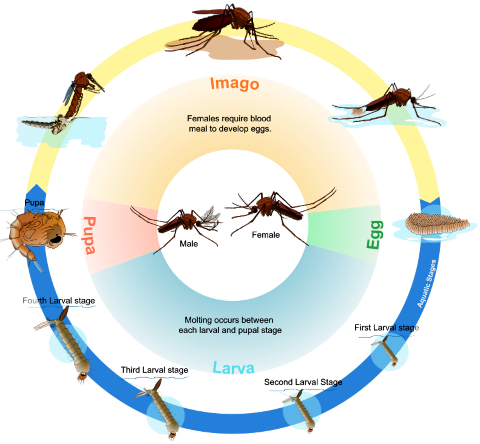 An adult female lays about 100-200 eggs. Some mosquitoes lay eggs on the water surface in clusters called rafts; others lay them singly on the water's edge. Also depending on the species, mosquito eggs can hatch into larvae within 2-3 days, or they can survive over the winter months. Some can withstand dry periods lasting several years, then hatch when conditions become favorable.
In the Moab District, many millions of mosquito larvae are found in the wetlands along the Colorado River. Larvae are also found throughout the Moab Valley in irrigated fields and animal watering troughs. Fish ponds, abandoned swimming pools, artificial containers, even abandoned tires can hold huge numbers of larvae.
Larvae come to the surface of the water to breathe through a tube called a siphon. They feed on small organic particles and microorganisms in the water. Over the course of several days to a few weeks, mosquito larvae progress through four molting stages (called instars), becoming larger in each successive stage before developing into pupae.
Mosquito pupae also breathe air at the water's surface using two tubes on its back. Pupae do not eat but they are very active. Inside the pupa, the adult mosquito grows for several days until it is fully developed, then it splits the pupal skin and emerges to complete the life cycle. The newly emerged adult mosquito rests on the surface of the water, allowing itself to dry and all its body parts to harden before flying away to feed.
